All About Type IIA Diamonds
Most people stumble across the 4 C’s of a diamond when researching an engagement ring. After all, those play a major factor in determining a diamond’s value and cost. But some people like to take it a step further — and consider the diamond type when making a significant purchase. Wondering what diamond type means? We’ve got you covered.
Classification
Remember how as a kid, you learned about classification in biology class? There was domain, kingdom, phylum, class, order, family, genus, species — and the purpose of classification was to easily organize living organisms by shared characteristics.
Gemologists do the same thing with diamonds. However, in our case, we focus on the color and physical properties to assign type. GIA is the international authority when it comes to diamond types, and they have broken down diamond type into two categories and four subcategories.
Diamond Type
Diamonds created under natural conditions typically acquire other elements during the course of formation — most commonly, nitrogen or boron. The trace elements of other chemicals is what causes diamonds to have slightly different colors. For example, green diamonds take on their unique color because of their exposure to radiation.
In this case, the easiest way to think of diamond type is whether it has trace elements of nitrogen. Diamonds with nitrogen impurities are classified as Type I, while diamonds without nitrogen impurities are classified as Type II. Then they are further subdivided into Type IA, IB, IIA, and IIB.
Type IIA Diamonds
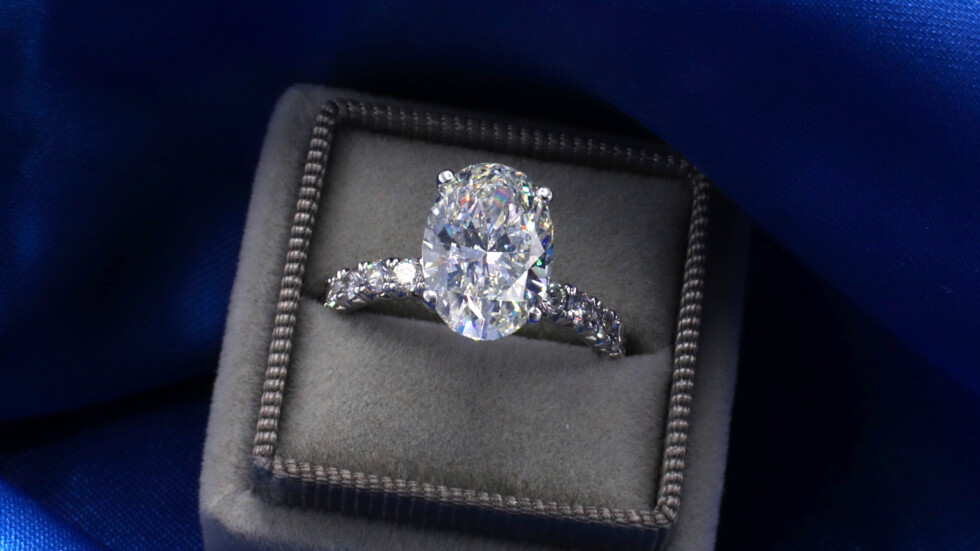
Under the classification system, Type IIA diamonds are those that contain no nitrogen or boron impurities. This makes Type IIA diamonds the most chemically pure of diamonds, and because of their lack of trace elements, they are usually colorless. However, they can be found in gray, light brown, light yellow, or light pink shades.
It is exceptionally rare to find naturally occurring Type IIA diamonds – less than 2% of all diamonds happen to be Type IIA. That’s why they are commonly thought to be synthetic diamonds grown in labs and require verification from a gemologist who can determine its origins.
Famous Type IIA Diamonds
Elizabeth Taylor’s jewelry collection was notably extravagant — to the point where she authored a book called “My Love Affair with Jewelry.” However, one of the most significant pieces was the Krupp Diamond, given to her by her husband twice-over, Richard Burton. The diamond clocked in at 33-carats and is a Type IIA Asscher cut diamond. Upon her passing, the gem was promptly renamed the Elizabeth Taylor diamond when it was put up for auction – and sold for $8.8 million.

Another notable Type IIA diamond is the Cullinan Diamond, which was found in South Africa in 1905 and weighed in at about 3,106 carats — or just under 1.5 pounds. Due to the stone’s size and weight, it was cut into nine large stones and 100 smaller ones by I.J. Asscher and Company (yes, that Asscher of the Asscher cut). The largest of the cut stones was cut into a pear-shaped gem and set into the British monarchy’s Sovereign’s Sceptre with Cross. The stone itself is known as the Great Star of Africa, or Cullinan I, and it weighs more than 530 carats.
Diamonds truly are forever — especially when they’re as flawless as a Type IIA diamond!
Now that you’ve mastered the 4C’s and know more about diamond types, it’s the perfect time to explore our collection! Call us today or contact us online to request an appointment with one of our certified experts!